| *NEW* The Jefferson Journal: Watermelon Greening of Virginia |
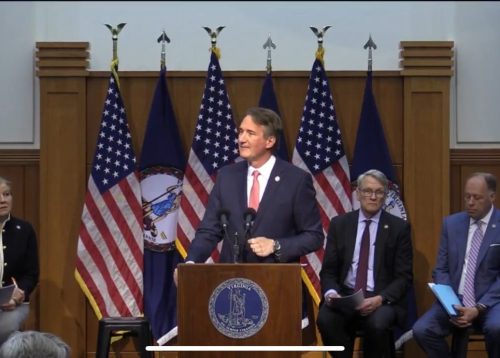
| By Dr. David Schnare Governor Tim Kaine's Executive Order seeks to green state government by reducing energy usage. Sounds good, but is it a bit like a watermelon -- green on the outside, but red(ink) on the inside? (7/2/2009) Read it here!
|
 |
| *NEW* Climate Change -- June 2009 Economic Forecast |
| This tenth annual economic forecast, prepared by Chmura Economics and Analytics, forecasts a 1.6 percent decline in empoloyment in Virginia for 2009 and expects employment increases to begin in the second half of 2010. Housing permits will further decline 18.8 percent in 2009, after falling 33.9 percent in 2008 but will rebound and grow by 5.5 percent in 2010. This year's forecast analyzes a variety of Virginia economic sectors, including technology, the labor market, income, retail sales, and the housing market. The forecast also provides key projections for each of 11 Virginia Metropolitan Statistical Areas. Finally, Dr. Chmura, who served on the Governor's Climate Change Commission, discusses the economic impact of proposed actions to confront climate change. View the 2009-2010 Economic Forecast
Past Years' Economic Forecasts:
Read 2008-2009 Forecast
Read 2007-2008 Forecast
Read 2006-2007 Forecast
Read 2005-2006 Forecast
Read 2004-2005 Forecast
Read 2003-2004 Forecast
Read 2002-2003 Forecast
Read 2001-2002 Forecast
Read 2000-2001 Forecast |
 |
| *NEW* What Are TAG Grants for Students With Disabilities? -- June 2009 |
| What are Tuition Assistance Grants for Students With Disabilities? A new brochure published by the Thomas Jefferson Institute for Public Policy outlines this idea – used in five other states – that provides assistance for parents seeking to find the best educational opportunities for their child with special needs. The brochure describes how TAG grants would work and answers common questions. You can download a copy here, or write to the Institute at info@thomasjeffersoninst.org for free copies. |
 |
| Why We Should Explore for Energy Offshore Now! -- April 2009 |
On February 19th, 2009, Governor Kaine asked the Federal government to delay oil and gas exploration off the Virginia coast. Attorney General Bob McDonnell and Lieutenant Governor Bolling, in separate letters to Interior Secretary Salazar explained why it is in the interest of Virginia and the United States to maintain the current exploration schedule, a position reflecting a large majority of Virginia and U.S. citizens. As this issue has become a political matter, the Thomas Jefferson Institute's Center for Environmental Stewardship has prepared this fact sheet and powerpoint briefing to ensure the debate is based on the best information available.
The Thomas Jefferson Institute is committed to sound science and careful analysis. In preparation of our original fact sheet on Virginia Off-shore Oil and Gas, the Institute made a computational error that our peer reviewers missed. An associate discovered it a few days later and that error has now been corrected. That revised fact sheet is now posted here, but despite the original computational error the important conclusion remains the same: There are significant oil and natural gas resources off our coast, and their development can not only help Virginia create new jobs but add to the state treasury.
View Powerpoint
View "Fact and Fiction" Briefing Paper
|
 |
| Better Education for All Children: A Virginia Educational Improvement Tax Credit -- January 2009 |
No issue is more challenging for the Virginia General Assembly this year than the budget. But while opponents of parental choice argue that a tax credit for corporations offering scholarships for children to attend the public or private school of their choice would drain the state treasury, nothing could be further than the truth. This fiscal analysis -- using the latest Department of Education statistics -- demonstrates how wrong that assertion is. In fact, such a tuition tax credit would have a positive fiscal impact.
.
View the 2009 Study
View the 2008 Study
View the 2007 Study
View the 2006 Study
View the original 2005 study
|
 |
| Black Neighborhoods Support More Parental Options! -- January 2009 |
More than 76 percent of voters in majority black Petersburg, Richmond and Norfolk neighborhoods overwhelmingly support school choice for parents in their school division. That's the conclusion of a recently-completed survey of more than 2,200 voters in overwhelmingly African-American voting precincts, conducted by the Thomas Jefferson Institute and the Black Alliance for Educational Options (BAEO). Support for more options -- from tax credits to scholarships for students with disabilities to charter schools -- runs high among parents and non-parents alike.
View Press Release
View Survey Results
View City-by-City results
|
 |
| Geoengineering and the Four Climate Change Truths -- November 2008 |
At the Research Triangle Institute in November 2008, David Schnare, Director of the Jefferson Institute's Center for Environmental Stewardship, discussed climate change from a political theory perspective, with reference to geoengineering as a means to break the political roadblocks. In a thought-provoking presentation, he examines Malthusian and post-Marxist approaches to culture change as the apparent template used by climate alarmists and other environmental activists to force centralized governmental policies and eliminate traditional American entrepreneurialism from the mix of alternative approaches to climate change. The presentation discusses how geoengineering will likely break the centralized governmental response due to its low cost and the opportunity it provides for development of private sector solutions to climate change challenges.
View Presentation (3.8 mb powerpoint)
|
 |
| The Economy and The Environment -- October 2008 |
In an internal analysis of the U.S. economy and federal environmental spending, Center for Environmental Stewardship Director David Schnare conducted a brief review of the relationship between the health of the economy and its effect upon environmental spending. Notably, significant changes in the former do not appear to much affect the latter. The leaderwship of the political party is correlated, but not in the manner expected. Democratic Prewsidents are slower to increase environmental spending than are Republicans.
View Paper
|
 |
| Eighth Annual Fairfax County Budget Analysis: Budget Crisis Self-Created -- October 2008 |
The budget shortfall of more than $400 million in Virginia's largest county was brought about by too much spending in good economic times, says the eighth annual analysis of the Fairfax County Budget. This annual study compares Fairfax's actual spending increases over the past four years against what those increases would have been if they had been limited to the rate of inflation and population growth. The two volume report also makes 16 recommendations for reining in county spending.
Read FY 2009 Budget Study Narrative Overview
Read FY 2009 Budget Study Appendices (5 mb file)
View FY 2008 Analysis
View FY 2007 Analysis
View FY 2006 Analysis
View FY 2005 Analysis
View FY 2004 Analysis
View FY 2003 Analysis
View FY 2002 Analysis
View FY 1998 Analysis
|
 |
| Virginia Climate Commission Update -- August 2008 |
| With new information frequently becoming available on the facts surrounding the debate on Global Warming, the Jefferson Institute’s Director of Environmental Stewardship. Dr. David Schnare, was asked to submit to the Governor’s Climate Change Commission, an update to his May testimony. This updated information was provided to the Commission at its August meeting. View Document
|
 |
| 2007 Annual Report: Jefferson Institute Impacts Public Policy -- July 2008 |
| The Thomas Jefferson Institute continues to impact state public policy like no other independent public policy foundation -- from increasing government transparency, to defeat of universal pre-k, to cleaning up the Chesapeake Bay and using geo-engineering to manage climate change. And we expect more of our ideas to become policy in the years ahead. View the 2007 Annual Report
|
 |
Copyright © 2004. Thomas Jefferson Institute.